Hallie

BOOK STACKS

To create these book stacks I went to the Guelph library and began looking through the shelves for any titles that I thought had potential for my stacks. I ended up deciding on the books below and captured these photos in different locations to help accentuate my created sentences. This first stack (The Aesthetic Body) suggests a concept or image of a beautiful and or artistic form that exists in a distant, unreachable place, free from external constraints or limitations. The second stack (Be Very Afraid) suggests that aging is a significant aspect of life that can evoke various emotions and experiences, including both fear and growth. It invites the reader to reflect on their perceptions of aging and its impact on identity and existence. The last stack (Shameful Behaviours)suggests a range of ideas or emotions related to personal relationships, experiences, or situations, such as a fight that had occurred leaving there to be an incident where the couples had disputes and ended up breaking up.

1. The Aesthetic Body

2. Be Very Afraid

3. Shameful Behaviours


ARTIST RESEARCH

Rebecca Belmore

Belmore’s known for her powerful and thought-provoking work that often addresses issues related to Indigenous rights, identity, colonialism, and social justice. I was drawn to Belmore’s performance art, as her own physical body is present in a majority of her peices as a means of expression, enabling her to explore the self and community boundaries between her own ideas and those of the viewer. She incorporates photography and video into her work to document her performance and create visual narratives that complement her themes. Additionally, Belmore creates sculptures and installations that often incorporate found objects and materials with historical and cultural significance. This aspect immediately seized my attention, lending greater strength to her artwork. She frequently employs symbols and metaphors in her work to convey complex ideas and emotions, allowing viewers to interpret the meaning on multiple levels.

Overall, Rebecca Belmore’s art is characterized by its multi-faceted approach, blending various mediums and strategies to create works that are not only aesthetically engaging but also deeply meaningful and thought-provoking in their content and messages, serving as a platform for dialogue and reflection on important societal issues.

Fountain (2005)

In “Fountain”, Belmore repeatedly carries heavy buckets of ocean water, symbolizing the enduring Indigenous struggle against colonization, with water representing the journey’s challenges and witnessing the transformation from Indigenous beauty to oppression. The bucket itself symbolizes the weight of colonization’s burdens on Indigenous people, mirroring their centuries-long oppression. A distant fire unites land, water, fire, and air’s elemental forces, channeled through her body. Fire, crucial to Indigenous life for ceremonies and sustenance, also mirrors its destructive capacity, akin to the devastation of Indigenous culture during colonization. Belmore emerges from the water, walks toward the camera, and throws the water, which turns blood-red, symbolizing the connection between water and humanity. The act shifts the burden of Indigenous history’s bloodshed cycles back to its European source, illustrating how purity turned to violence due to colonialism. Red, signifying pain, represents the blood spilled in the abuse of Indigenous people, emphasizing the ongoing impact of brutality and colonization. Belmore’s work highlights the tragic repetition of such acts between water and blood.

Biinjiya’iing Onji (2017)

Rebecca Belmore has created a memorial to transience using locally sourced materials. She has painstakingly carved a tent, which is increasingly becoming a long-term dwelling for refugees and migrants, out of marble. This sculpture serves as a testament to the enduring state of crisis and the makeshift havens it compels. The tent’s design also draws inspiration from other traditional shelters, notably the wigwam, a significant part of Belmore’s Indigenous heritage. Wigwams, traditionally constructed with young tree branches and covered in birch bark, showcase a resourceful approach to building with available materials, allowing nomadic communities to establish homes wherever needed.

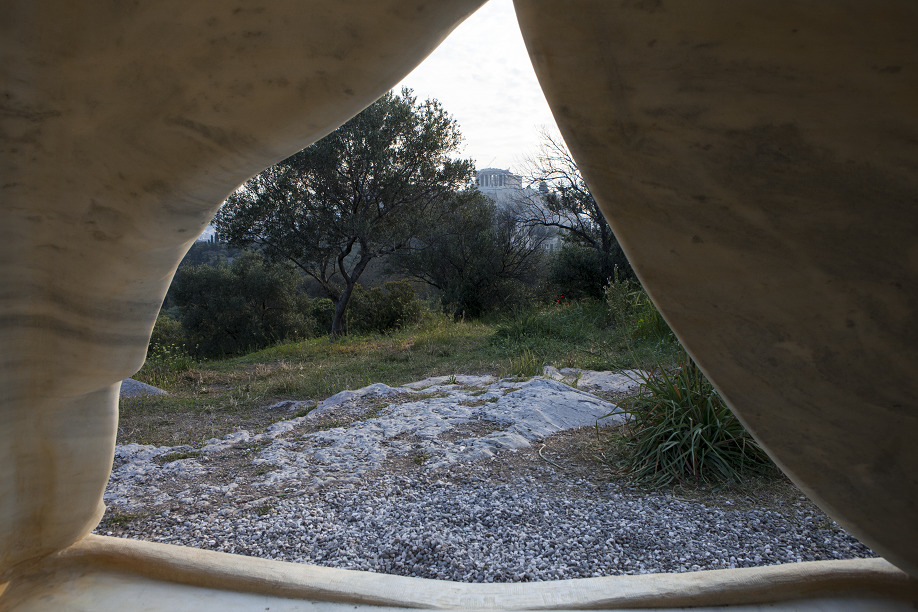
Rebecca Belmore responds to nature, creatures, and environmental conditions in her work by often incorporating natural elements, materials, and symbols that hold cultural significance, particularly as they relate to Indigenous perspectives. Her response is deeply informed by her Anishinaabe heritage and her commitment to addressing pressing issues. Belmore conducts fact-based research by delving into Indigenous histories, traditional knowledge, and contemporary challenges. She collaborates with Indigenous communities to ensure her work is authentic and representative. Her work is motivated by ideas of Indigenous sovereignty, resilience, and cultural survival. She values the importance of giving voice to Indigenous experiences and challenging the historical and ongoing injustices faced by Indigenous peoples. These ideas resonate in her final works through various mediums such as performance art, sculpture, and installation. Many of Belmore’s works, such as “Fountain” and “Biinjiya’iing Onji” are intended to challenge the status quo and raise awareness about social and political issues, Indigenous rights, identity, and the interconnectedness of nature and culture.


ENVIRONMENTAL VIDEO RESEARCH

1. Chickadee

  • SONGS: Across the majority of North America, you can typically hear a straightforward, melodious song consisting of two or three clear whistled notes, often resembling “fee-bee” or “hey, sweetie.” However, in the Pacific Northwest, the song differs slightly, featuring three or four notes at the same pitch. In many regions within its range, male birds commence their singing in mid-January, and as the winter season unfolds, the frequency of their song gradually intensifies. Interestingly, females in this species also occasionally join in with their own songs.
  • CALLS: Chickadees employ their distinctive “chickadee-dee-dee” call, which includes an increasing number of “dee” notes, as an alarm signal when they sense danger. Additionally, they utilize a specific gargling call, particularly in confrontational situations, such as when a lower-ranking bird approaches a higher-ranking one. This call is also exchanged between members of a pair. In the case of Black-capped Chickadees, they emit a high-pitched “see” call as a high-intensity alarm signal, typically in response to the presence of a rapidly approaching predator. When other chickadees hear this alarm, they instinctively freeze in their current position until they receive the reassuring “chickadee-dee” call, which signifies that the threat has passed. Notably, the high “see” calls are most frequently produced by male chickadees.
  • OTHER SOUNDS: Nestling chickadees employ a defensive strategy by emitting a sudden and forceful hissing sound while simultaneously striking the interior of their nest cavity when they perceive an intruder peering inside.
  • To hear samples of the calls and songs of the Chickadee, click on the following link:
  • https://www.allaboutbirds.org/guide/Black-capped_Chickadee/sounds#

2. Eastern Screech Owl

  • SONG: Their most common song is a high pitched tremolo that can sometimes resemble a soft “purr.” It is a 3-6 second long song that the screech owl uses to keep in touch with their family or mate. The second song is one called the whinny. It is a 0.5–2 second long shrill that resembles the sound of a horse neighing, and is used to defend territories.
  • CALLS: Screech Owl calls can often sound like a soft, low “caw” or “hoot” sound. As their name suggests, these owls can also produce a screeching call that is used to indicate danger, alarm, or agitation. 
  • To hear samples of the calls and songs of the Eastern Screeching Owl, click on the following link:
  • https://www.allaboutbirds.org/guide/Eastern_Screech-Owl/sounds

3. Loon

  • Loons exhibit a diverse range of vocalizations, comprising four primary types: the wail, tremolo, yodel, and hoot.
  • The wail, often the most frequently heard, is a haunting call employed by loons when they find themselves separated from their chick or in cases where their mate has not returned. It serves as an expression of their willingness to engage with others.
  • The tremolo, conversely, serves as an assertive response when loons feel disturbed by boaters or potential predators. This wavering call communicates their distress and encourages a move to a safer location. It also functions as a means of announcing their presence at a particular lake.
  • The yodel is another vocalization that signifies aggression and is typically emitted by males during confrontations. It plays a crucial role in territorial disputes, effectively conveying a message to nearby loons, asserting, “This territory belongs to us!” Interestingly, each male loon possesses a unique signature yodel, which they may modify if they relocate to a different territory.
  • Lastly, the hoot is a softer, brief call used to symbolize curiosity and/or happiness. Loons employ hoots to maintain contact with one another, with parents using hoots to communicate with their chicks and mates hooting to stay connected with each other.
  • To hear samples of the calls and songs of the Loon, click on the following link:
  • https://naturecanada.ca/news/blog/the-common-loon-what-are-they-saying/#:~:text=They%20make%20four%20basic%20types,its%20mate%20fails%20to%20return.

4. Pileated Woodpecker

  • CALLS: The Pileated Woodpecker call consists of a fast staccato high pitched repeated sound. The call can last up to several seconds. They have a second call that is more spaced out and is lower in pitch. It usually sounds like cuk, cuk, and indicates danger, or marking of territory.
  • OTHER SOUNDS: Woodpeckers are most known for their drumming sound that they make by repeatedly pecking their beak against a tree trunk. This sound may be used to solicit mating/courtship, or to alert others of a predator near a nest. For males, drumming may also be used to mark or defend their territory.
  • To hear samples of the calls and songs of the Pileated Woodpecker, click on the following link:
  • https://www.allaboutbirds.org/guide/Pileated_Woodpecker/sounds

ENVIRONMENTAL VIDEO BRAINSTORM

Idea 1: Hanging from a Tree Until you Fall

“hanging from a tree until you fall” serves as a thought-provoking symbol that unites environmental concerns with the human experience. It underscores the importance of perseverance, resilience, and responsible stewardship of our natural world while acknowledging the inevitability of occasional setbacks in our journey toward a sustainable future.

Idea 2: Hide and Seek

Hide and seek in the forest is more than just a childhood game; it’s a transformative encounter that binds individuals to the natural world. Through sensory immersion, physical interaction, and environmental awareness, participants learn not only about the forest but also about themselves. This connection between body and nature cultivated through play endures, fostering a lifelong reverence for the natural world and a desire to preserve its beauty and vitality.

Idea 3: Imitating Bird Sounds (FINAL IDEA)

Embracing the harmonious symphony of nature, our project focuses on the art of imitating the bird sounds in Ontario. This endeavour offers a unique opportunity to compile an auditory journey, seamlessly weaving together recordings of individuals own attempts at replicating these sounds. Here, we immerse ourselves in the richness of the environment, capturing the chirping of birds. It’s an exploration that celebrates the interconnectedness of humans and nature and invites listeners to experience the beauty of the outdoors in a novel and creative way.

ENVIRONMENTAL VIDEO PROGRESS

During our first outing to film our video, Alexia and I went to the mall. We went up to people and asked them to be in our video. However, this proved to be difficult, because many people said no and it was hard to find people who said yes.

For our second attempt, we went to campus and stood outside with handmade signs that said ‘BE IN OUR VIDEO’ and another that said ‘MAKE A BIRD SOUND. JUST 5 MINS OF UR TIME!’ This was much more effective, because we weren’t putting people on the spot. Their participation was a little more voluntary.

We went to the mall again for our third attempt, and ended up making a sign in front of Michael Hill that said which “MAKE A BIRD SOUND AND GET 20% OFF AT MICHAEL HILL!!” helped us to get some attention and get more people to be in our video.

ENVIRONMENTAL VIDEO PROGRESS (final re-edited)

“Primal Instinct”

For this assignment, Alexia and I were driven by the ambition to narrow the divide between humanity and nature. Our mission sought to illuminate the primal connection by peeling back the layers of conventional verbal communication, directing our focus to the raw, fundamental ability of individuals to produce sounds. The intentional decision to feature individuals spanning various ages served as a poignant reminder of the intrinsic nature of mimicry and noise-making, characteristics often prevalent in infancy as one explores bodily functions and vocal capacities for communication. Despite societal norms that tend to suppress such behaviors as we age, the inherent urge to vocalize and replicate sounds persists, deeply rooted in our nature.

Throughout the immersive filming process, which engaged a diverse group primarily composed of strangers, shared moments of laughter became the threads weaving a genuine bond among participants. This collective experience served as a profound testament to our universal inclination to express ourselves through vocalization and imitation. In capturing these authentic moments, our project not only aimed to bridge the gap between humanity and nature but also to celebrate the enduring, natural ties that bind us all through the expressive art of sound.

ARTIST BOOK PROGRESS (pdf version)

ARTIST BOOK FINAL (hard copy)

For this project, my primary goal was to delve into the nuances of scanning ordinary items, such as rubber bands, string, underwear and more by incorporating dynamic movement, specifically by dragging them across the scanner. By embracing this unconventional approach, the project aimed to go beyond conventional static representations, seeking to capture the inherent beauty and variability that emerges when objects are subjected to movement during the scanning process.

Through this dynamic scanning technique, I wanted to illuminate the interplay between form and motion, allowing each item to undergo a metamorphosis in the scanner’s interpretation. The visual outcomes, a combination of the ordinary item on one side of the page and the extraordinary on the other, serving as a testament to the artistic potential inherent in the mundane. This project not only aimed to explore the technical capabilities of scanning but also to evoke curiosity and appreciation for the artistic possibilities embedded in everyday objects through innovative and dynamic perspectives

ARTIST MULTIPLES (cut out)

ARTIST MULTIPLES (digital files)

In the conceptualization of this project, my vision was to create a harmonious blend of realistic scanned images of bandaids alongside whimsical, cartoon-like renditions transformed into sticker form. Traditionally associated with physical injuries, bandaids serve as symbolic healers, but I aimed to redefine their significance by shifting their purpose from addressing wounds to adorning everyday objects.

This involved meticulously scanning actual bandaids, capturing their realistic textures and details, and also drawing them using procreate to create cartoon-style renditions. Transforming these creations into stickers added a playful and versatile element to the concept, allowing them to transcend their conventional usage.

The intention was to challenge the conventional association of bandaids with physical injuries and imbue them with a new meaning — one that extends beyond wounds to celebrate the healing potential within various aspects of our daily lives. By turning bandaids into decorative elements for objects, the project is to invite viewers to reconsider the symbolic power of these everyday items and embrace a more imaginative and positive interpretation.

Shan

Experimental Studios 3

Blog Post – Rebecca Belmore

Rebecca Belmore is a member of the Lac Seoul First Nation (Anishinaabe), and is known as a multidisciplinary contemporary artist. Her art practice is grounded by current; participating in a call to action. Most of her work is her responding to current issues like land and water rights, violence against Indigenous people by the government, and the role of the artist in contemporary life(to name a few).

Torch, 2014 Photograph

This work connects the symbolism of the Lady Liberty statue to the forced displacement of Indigenous peoples. Bound by the flag holding uprooted long black hair instead of the torch of enlightenment. Belmore’s ability to make a clear statement to her wide audience by using symbolism to make people think deeper about the violent impact colonialism has. Even though this work isn’t directly interacting with nature, it is definitely responding to North American (Lady Liberty symbolism) Indigenous Peoples land being stollen(flags), and their populations being forcibly displace(uprooted long black hair).

Wave Sound, 2017, Sculpture

Rebecca Belmore created sculptures for a handful of National Parks, with the intent to encourage visitors to pause and listen to to the natural sound scape of the land. The sculpture’s are in the shape of a horn that varies in aesthetics to fit the landscape for example; length – using rocks in the landscape to keep it propped up, material – blend in with surroundings, etc.. The sculptures themselves are quite large but, there is only ever enough space for one person to listen at a time and they are quite low to the ground forcing the listener to get close and personal, creating an intimate setting to reflect on your relationship with nature. Each sculpture had a lot of thought put into it, in order to respond to all the different locations but also research in order to know what shape and what materials are needed to amplify the sounds that surround it.

Some more interesting work!

Book Stacks

I chose to look through my recently deceased Mother’s library for this assignment. I started off with the intent to find books that might relate back to our relationship and where she searched for parenting advice. I started with trying to think of it as a possible order of events to why she even wanted kids to begin with. Then I chose to humorously demonstrate a sort of escalation in my mum’s searching for some sort of control while raising me, the spirited child. I enjoyed getting to know my mother better while looking through her book collection; I could tell which books were her favourites, the ones she must of started many times but could never finish, others that had no interest to her and were obviously bought so she could learn more about her loved ones interests like hockey, I found books that looked all to familiar, books that have survived decades of school children’s sticky little hands, and of course her paper cover copies of her favourite books that she annotated. This insight into my mum only happened when I stepped away from how the books related to our relationship and focused more on building imagery through story telling or humour. Having to categorize Her books with a different intention had me pay closer attention to all the little details, things that would be normally overlooked.

Blog Post – Environmental Video Art Proposal

A lot of time went into the HOW of it all. In order to make our paints we needed to understand each step of the process; from foraging materials and extracting the refined pigment, to making binders and additives, and the crucial ratios. Our video cycles through each step for each pigment with a focus on the mixing of the pigment and the binders.

Video Art

We really wanted to follow our intuition and use everyday items when it came to selecting pigments but also keep in mind some more modern ways to forage pigments. We made sure that we had an array of different materials like stone, leaves, flowers, berries, ash, household items, studio items etc.. This practice reconnects you to your environment because it forces you to pay attention to your surroundings in a different way. Some examples of contemporary methods of foraging are listed bellow.

Flour – Frothy Ivory – foraged for pigments in own pantry

House Brick – Salmon Blush – Foraged for pigments by scraping the brick from my own home

Weed Leaves – Oui’d – Foraged through community

Rubber Car Mat – Car Sludge – Foraged from the car mat from the passengers side of my car. This paint has a little piece of everyone/ everywhere I’ve been

Blue Acrylic Paint – Liquid Plastic – Foraged from Becca’s home studio. Great to expand the life of your paint.

Lavender Incense Ash – Cleansing – foraged from alters

Assorted leaves – Tina Belchers Zombie Boyfriend in a jar – Foraged by lying down on the ground waiting for leaves to land on us.

It’s quite poetic if you think about all the effort that was put into each step but the videos of mixing the pigments and binders together is what memorizes the viewer.

Field Trip!

Book

Becca and I wanted to create a book that details how we made each pigment from our video. Our goal was to document our process in an educational way to encourage others to also participate in this practice. We created two books, one that is able to be printed and the other acts as the original that can forever be added to.

BOOK SPREADS

Both Books

The Original Book Spreads

The images are out of order… the binder clips allow for the pages to be rearranged and for pages to be easily added and removed.

At the end of the book I added pages that are ready for a new pigment and future en plein air paintings using the pigments we made.

-Fun extra Details-

I crochet a bag to hold our book so that it would be easy to transport.

I knot weaved a bookmark using floss and bead’s I already had. I wanted the bookmark to symbolize Becca and I’s collaboration by using the colour palette I associate with Becca and my love for the sky through the bead choice and alien spaceship.

Multiples Project

I was having a difficult time with this project because I was really set on using the scrap art materials I have collected over the years and my idea being representational. So I asked myself what kind of multiples are representational? (wedding rings, military grave markers, religious paraphilia, tourist souvenirs, friendship bracelets, and Kandi at concerts)

All these types of multiples attempt to memorialize a person, relationship, shared experience, place, or promise. I was really drawn to Kandi because, the plastic beaded bracelets/jewellery are exchanged by strangers through an understood mini ceremony.

The bracelets I made are to by given to a stranger when you witness them doing a simple act of kindness. It doesn’t have to be an act of kindness done for you but one you witness. This includes holding doors open, picking up garbage, letting someone cut in front of them, complements, giving directions etc.. The first one I gave was to the women who pulled over and helped me when I got into a car accident on my way to critique.

I crochet bracelets by using floss and beads I already had refusing to waste any floss. The eclectic use of different coloured floss and beads act as a decorative element that implies importance. I also decided on crocheting the bracelets to be representational of a vine to symbolize our growing community and how we are all connected.

Bella

Artist Multiples

Final Matchboxes

For my artist multiple I made matchboxes that were in conversation with female rage. As a young, female-presenting artist, and not simply an artist but a person, I have come in contact with adult babies too many times. Often, they are male. The frustration that women seem to carry with them and conceal behind apologies and higher roads is a feeling that I’m sure many can relate to, and it is one that is cyclical. This meaning, the fact that we constantly have to remain professional while these men attempt to remove our agency of their own accord, and then when we stand up for it they have a tantrum? ridiculous.

But, as I am told “this is just the way things are”. B U L L S H I T. These are only the way things are if we allow them to stay this way. I know so many strong and capable women. Women who are aware of their agency and own it. we. need. to. speak. out. we need to burn things down. we need to yell and scream and tell them what they’re doing is not okay. AND because we are trained from such a young age to sit still and pretty, we can do all of this, while remaining professional. Professionalism does not equate to being quiet or sitting still. Clearly.

My artist multiple of matchboxes are just a small drop in the puddle of the fight to “burn the patriarchy”. I believe in my generation. I believe we can make a change. and I believe that as artists, we have a unique perspective and advocacy on matters such as these.

Process photos

I tried a couple of different options for the “i dare you” at the bottom of the box. Originally I just had text, like I did on top, however, I didn’t feel like this was the most successful option. I then dried my ink out a little and printed full black with “i dare you” carved out. I allowed the ink to try a bit so that the bottom would resemble a sort of ashy burnt look.

I have to finish them a little with some kind of coating, because of the material of the matchbox itself the printmaking ink feels a little dry and as if it could be scratched off. I want the coating to be matte for the boxes though, so the burnt effect remains.

further thoughts in process

Sitting with my ideas and designs for a couple days I have decided to go with the pink matchbox and have the text “Ask me why I’m mad.” printed on the top with “i dare you.” printed small on the bottom of the box. I have decided to put the vertical graphic of the women on the inside of the matchbox, underneath all the matches, so only when you have used all the matches are you able to see the release of the woman screaming.

working through ideas

First I looked at colours for possible ideas

These were my favourite;

I liked the blue but it made me think of weddings and baby showers. The red was nice but I was worried about the aggressive on aggressive and having it be “too much” in a way. I wanted the text or graphic I chose to speak in conversation with the colour of the box, rather than fight for attention. I loved the green but just cause I loved the green, I didn’t think it would work very successfully for what my concept was. The pink was the winner.

I then went in and started toying with different text ideas I could print onto the box. I’ve decided to carve intaglio blocks to have slightly imperfect printing on the boxes and have them vulnerable and messy.

These were two of my original ideas;

Jumping off from these ideas, specifically the text “Ask me Why I’m mad” I came up with 4 more possible designs.

These first two were good but not “just right”

The next two are my preferred ones;

original brainstorming

My first thought was to work with matchbooks. Simply because I collect and enjoy matchbooks and it felt very true to myself as an artist to create this as my multiple. I toyed with the idea of working with a zine concept I’m working on right now for a future exhibition however, after discussion, matchbooks seemed to be the overwhelming yes, and also something I’ve wanted to create for a long time so it felt right.

I want to make matchbooks that are a little passive-aggressive, or aggressive-aggressive… I love the Michael Drebert poster we have in the classroom that playfully and vaguely discusses using all the available light to make a fire in Vancouver, hopefully, one that is big enough.

Book project PDF’s

Book project Processing

Layout Option 1

Pages would continue similarly

or

Layout Option 2

CONTINUED WITH MY PHOTOS and then

and such and so forth for each person and their rolls.

MY THOUGHTS ON LAYOUT

I think that the first layout is more successful and allows more freedom throughout the arrangement of all the photos. I also have a significantly larger amount of photos than the other contributors, simply just cause I pulled from more rolls and shoot more often. I think the separation would be jarring and wouldn’t flow as nicely. Especially after having pages upon pages of my photos and then just a couple pages each of theirs.

My question is then, should I credit line each photo with a name? To give credit where credit is due? Or will that muddy the layout and the names at the front are enough?

full page spread? just the cover? full page bleed?

Book project continued thoughts…

I feel strongly about the idea of using my “bad photos”. I’ve gone through handfuls of rolls looking for all my technically wrong photos and I feel like I’m lacking in content. I reached out to some friends who are not studio art students but shoot film every now and then to see if they’d be willing to participate.

The idea that all these different people are shooting film, not just photographers or photo-based artist like myself, plays conceptually into an overarching umbrella of how photo is viewed as an art form. Of course, this is not the main idea in my book, nor do I want it to be. But it definitely brings an interesting field of thought to the table, and one that many photographers are aware of in our day and age. In fact, one that photographers have been aware of in one way or another throughout all of history.

Book Project initial thoughts and ideas

Automatically I was interested in doing some kind of photo book. I was swayed by the large collection of photos and textbooks I have that tell a narrative story connecting the two.

I want to use my own photos, likely film, as that’s what I prefer to shoot and shoot more often.

Looking through my rolls and negatives I want to use the photos that would generally be discarded or brushed off. I’m not sure if I want text alongside it still. I toyed with the idea of lists, as that’s another interest of mine, but after speaking with Diane we agreed it would be too separate from one another, and would be like an amalgamation of two books in one, which is muddy and not the goal.

TORONTO TRIP – October 21st

The trip to Toronto was so nice! I loved MOCA a lot. From the concrete permanent installation on the first floor, to the contemporary sculpture and photo above it was a beautiful experience overall. I always enjoy seeing contemporary art, especially because of the different ways to install and hang that are not standardized museum technique. It’s very reassuring as a young artist to see different ways to exhibit work and I find contemporary establishments are always where I’m able to see this, especially if the exhibition is not strictly photography, as photography is always hung differently than a painting would be.

I thoroughly enjoyed Liz Magor’s work. The way that she used sculpture and sculptural techniques was very thought-provoking and the inherent “strangeness” of the works itself made it incredibly interesting visually and conceptually. (Also, I want one of those flashlight-holding monkeys as a desk light)

Dancing in the Light was also a beautiful exhibition to walk through, and I loved seeing the curatorial work of the show. Having over 40 artists in it the portraiture exhibition was vast and as a student who’s been enrolled in many museum studies courses, curatorial styles are always of interest. The collection of books was an incredible installment in the exhibition, creating a conceptual and participatory element to the exhibition which is an evergrowing and important idea in museum and gallery culture.

The video project her name shown at TPW was a beautiful moving piece. The set up of couches, bean bags was so smart for what the film was and what it spoke about. The couches are “grandpa style” for “familial and physical comfort” as stated in the artist’s statement. The room where the film was shown is also painted yellow to enhance the feeling of ceremonial living, as this colour is often used in ceremonies. After watching the film I researched the artist duo and their words behind the exhibition and in doing so read about the adjacent room to the film room, where they created a smudging room we did not explore greatly, cause of time. This room is painted blue to feel reminiscent of Saddle Lake. Each decision was made so purposefully, and this is incredibly admirable in an artist and so nice to see so clearly in exhibition spaces and artist statements.

Kensington Market is always a space full of art and joy. It’s also a dangerous place for my wallet, but I never regret it.

Video Project

afterthoughts

In the future, I think I would personally remove the zoom-ins. Though I agree that it allows the viewer to see the more intimate moments I think it’d be more successful if they were able to find those on their own. I also think if we shot in a higher resolution this would be more successful as well, rather than having the grainy effect showing low-resolution quality.

In our piece cows, the boys followed our instruction “be a cow” and explored this idea physically and mentally for a 10-minute period. It was raw and touching and I think Jillian said it best when she wrote ” Small differences occurred; some would moo at one another, others laid in the grass alone. Cumulatively, however, each male became a cow, a female, not a horned bull. In a sense we have allowed for the male participants to use their bodies in a transformative manner. In this state, they seemed to convene in a deeply honest manner that veers away from the hyper-masculine social codes young men seem to adhere to.”

FILMING October 5th

The filming went so well. We set up two mics. One in a tree out of the frame and one on the ground behind another tree on the opposite side. If we were to do this again I think we’d be more deliberate with how we began the recording, ensuring we started them all at the same time so that editing went smoother. The filming itself was good. We took the boys to a field and introduced them to the idea loosely, without telling them any conceptual meaning behind it. We had the camera set up already so they just had to begin. We shot a straight video for 10 minutes and cut it down in post. I like the idea of a long-shot video of this.

It was also just really nice to watch the boys explore this activity. It was really beautiful in a way I don’t think any of us expected.

Process Part 2

We’ve been back and forth with this idea. Even at one point toying with the idea of changing it altogether. However, we wanted to create a piece that we not only feel passionately about but also enjoy.

After a meeting on October 2nd, we came to a solid conclusion on what exactly we wanted and even how we would expand our idea if given the opportunity in the future and we’ve come up with a conceptual analysis that we thoroughly enjoy and are excited about.

Through additional research, we came across the master’s thesis of Florence Fitzgerald-Allsopp entitled Becoming-with-Animal: Cultivating a Feminist Understanding of Human-Animal Transformation in Contemporary Performance Art, which provided us with very helpful information relevant to our conceptual foundation of the piece as well as inspiration from other art mentioned throughout the thesis.

The idea of having men come in and act as cows is encouraging the males involved to play with the unknown territory of the animal they don’t know well, as well as the female gender. As I’ve mentioned in previous posts, cow is a term for female cattle. It evokes a certain image in a person’s mind.

If I say cow you’re likely picturing a black and white spotted cattle, likely with an utter, likely with no horns. Maybe in a pasture, possibly grazing.

If I say cattle you’re probably picturing the same thing but multiplied, possibly adding a male in there as well.

However, if I say bull I’d take a shot in the dark and say the image that comes to mind is a brown cattle, with horns, maybe a ring in its nose.

These key terms are important to our process. Giving the subjects the word cow as the basis of their improvisational performance inherently gives them the image of a female cattle and so urges them to act as such, without us having to provide this additional information for them.

We aim to represent this vulnerable state of exploring the unknown, in both animal and gender, with our male volunteers. We want to react to the idea of historically gendered animalistic tropes and view this through transformative performance.

It will be interesting to see how the men react to this with such little prompting. I’m sure some will be embarrassed and others fully embracing of the performance. It may be helpful for some to have others around acting as cows too, and for others possibly harmful (in a sense of self-conscious ideas). They will be in a safe and guarded space, away from pedestrians and on lookers, but the lens of the camera is also an eye on them which some of them, I’m sure, will be very aware of.

Source : Fitzgerald-Allsopp, Florence. (2019). Becoming-with-Animal: Cultivating a Feminist Understanding of Human-Animal Transformation in Contemporary Performance Art. 10.13140/RG.2.2.31102.43840. https://www.researchgate.net/publication/334165173_Becoming-with-Animal_Cultivating_a_Feminist_Understanding_of_Human-Animal_Transformation_in_Contemporary_Performance_Art

Process Part 1

To begin our process we contacted men that we know and asked them to take part in a performance art video project. We did not always share what we were making, leaving the actual improvisation up to the men at the time of filming, to create a more genuine experience.

We made and hung posters throughout campus; In Zavitz, the Bullring, Alexander Hall, and at the Gym. We also posted them through our social media to get intrigue from people online.

TUESDAY

I was not present for this mid-way critique, as I got Covid. However, I got very disappointing news from my group members while I was laying at home praying the vid away.

From what I was told, our idea did not go over well and there was lots of negative energy thrown at it, including from people who had previously been excited about our idea.

I am disappointed I had to miss this crit, as I wish I had been there to defend our idea with Jillian and Zoe.

We will do further research on the behaviour of cows however I disagree that we should have the men do the same. Part of the idea behind the project is the subtle social commentary on the role reversal of having men act as cows when “cow” is a term used in direct connection with a woman. Because of this role reversal, men should not know the immediate ins and outs of what it is to be a cow. We are acquiring male-identifying cis men. They have no experience with the idea of what it is to be a woman. As I stated previously in the early stages of conceptualizing this piece “men may be pigs but women are cows”. This unknowing improvisation based on assumed life and behaviour is an important aspect of the project.

Idea and Conceptual Ties

Last week when talking with Megan, myself, Jillian and Zoe (ZoZo) formed a loose idea of what we wanted to do for our video art. When talking it over with Megan she was very excited to see our final project and urged us to explore the idea further.

The idea of our video is to herd together a collection of men, bring them to a field, and ask them to improvise as cows.

Not only is this idea comedic but it also speaks to many larger themes and ideas seen in the world.

Cattle are something that, especially in Guelph, we see fairly often. Everyone has memories of road trips, small or far, where they see cows out the window and for some reason point and say “Cows!”.

Cattle are in the farming industry in more ways than one but are also well-loved as farm animals of less industrial scales.

They have many personality attributes that are similar to humans. They are socially complex; they can make friends, hold grudges, mourn, cry,. They show signs of advanced cognitive abilities, figuring out problems and enjoying the results of completion when they do.

This connection of cattle to the human experience creates play in our video, past that of the up-front humour that we will see with men acting as cattle.

Another playful anecdote of the video is the social commentary on how the term “cow” is used as a negative connotation to a woman, as many things are. Men may be pigs but women are cows. Using males to create a scene of “cows” in a pasture brings in a role reversal without outwardly attacking the entire male population.

If we had the men act as pigs the project would be much more surface-level.

Overall, the act of bringing in people to improvise as animals ties human nature to the animalistic tendencies that we have within. Cows are not the most aggressive animals, in fact, people are much more aggressive overall, however, it still connects human nature and animal nature together.

This video project will not only introduce generalized humour, but also force people to think about animalistic tendencies of human nature and cruelty, the human experience and subtle social commentary.

Meeting with Megan Arnold this week was very beneficial. It was nice to get to talk to an artist who is so young and open to ideas.

I was also a fan of a lot of Megan’s work that she shared with us.

As some of you know, I am not a fan of creating video art. In fact, the only reason I agreed to take this class was because I made sure there was less video art than the previous semester’s experimental studio. I seem to have been tricked a little bit, as here we are…making video art, but nonetheless.

One of my issues when it comes to making video art myself, past the fact that it is simply not what I enjoy creating, is the fact that with my art I hold it to a specific ideal of aesthetic. With my main focus being photography I am able to control all the elements going into it, and even if it’s an abject photo I can create a world in which that abjectness is the ideal. I enjoy video from a cinematographic lens.

I have a large interest in film but that is not what we’re aiming for in this course and though art is subjective, in school it often feels as though we are curving our practice to please each professor and their created ideals.

My favourite piece of Megan’s that she shared with us was “A Deal with Dog”. Part of my enjoyment of this piece was definitely derived from the fact that it was visually pleasing to my own eye. The blowing grass, the arching hills, the complimenting colours of the outdoors.

The piece itself had a touch of this cinematographic feel to it while it practiced Megan’s art techniques of comedy and cringe.

Environmental Art & Artist Research

Katie Patterson

I have become enamored with Katie Patterson’s work.

Future Library is a project that I am excited to share with my children and sad that I won’t get to experience it when the books are printed. I hope one day I can attend a ceremony for the handing over of a manuscript

The vastness of Patterson’s projects is what really gets to me. Not only Future Library most of her pieces.

One of my favourite pieces she has is To Burn, Forest, Fire. In this piece, she created sticks in incense to represent the first and the last forests on earth. As quoted on her website she said “Humans have used incense for thousands of years, mostly as a bridge to what dwells beyond the everyday, through prayer, oblation, and ritual. To Burn, Forest, Fire places that experience into the context of deep time and the living Earth community.”

Patterson created these two sticks of incense and then furthered the piece even more by taking them to a “variety places across Helsinki, and beyond” to burn them in almost a subtle performative way.

The immense research and time spent on this piece is eye-opening to me. The scientific nature of art that Patterson creates is a conversation that I don’t often experience in my own practice and it is one that I admire greatly.

On her website, she includes graphics of each forest with descriptions of the scent.

Another piece I simply adore is -there lay the Days between- in which Patterson created a tickerboard that displays the number of days the sun has risen since the earth was formed. Each sunrise the number changes.

Patterson’s works go beyond the concepts of space and time while closing the gap between the viewers and the cosmos. She shrinks the vastness of the universe in a minimalistic aesthetic to create a comfortable view of eternity.

Sources ;

https://katiepaterson.org/

https://www.futurelibrary.no/

Nina Katchadourian Book Stacks

When we spoke of Katchadourian’s book stacks in class I had some immediate ideas with my own library. Because of this, I chose not to use my own books. I went to my partner’s house, whose library is overflowing, and got to peruse the shelves to look for titles that stood out to me. I compiled a list of those titles and pulled some books to get started.

I think it was beneficial for me to use books I was not familiar with. Not only did it open up possibilities visually, but it also allowed me to play with titles I may not have encountered otherwise, and not be hindered by the bias of the narrative between its pages.

I chose to photograph them on a black background because I love how some of Nina’s photos are so stark. I used just natural light and a black drop cloth and tampered with the exposure as much as my phone would let me. Some are too dark for my preference but I tried to use it as another aspect to the story the spines were telling. I also tried to play with the frames of the photo and created compositions I believed fit the narrations.

For one specific stack – “We so seldom look on love/run towards the danger/together” – The colours on the spine of the bottom book were too dark with not enough contrast so I ended up shining a light on the word together to brighten it in the photo. This created an illuminative effect on the word but not the author and I think it successfully highlights the story being told in such little words just that much more.

In the stack with the most books I wanted a space between two books, to act as a breath or a comma of sorts. Originally I used thin white spined books but wasn’t content with the aesthetic of the image so eventually I found a thick hard cover book and turned it around so all you could see was the pages. This worked well.

The stack – “Other people/as they see us/side glances/the unsettlers” – Is my least favourite final photo. Not because of the spine choices, but rather the creases in the worn-out book “as they see us” and how it becomes almost difficult to read. I’m sure I could attribute this to some purposeful and conceptual meaning, but it was difficult to shoot and annoying to settle. Nonetheless, it was an interesting and meaningful stack.

FINAL IMAGES

I’d be interested to work with books again in the future. One thing that interests me greatly is the documenting of the “destruction” of books over time. I am someone who prefers a soft cover to a hard one because I like it when my books are noticeably read. I dog ear my pages and don’t mind a tear and sometimes, if it’s the best option, I’ll fold the book up a little and shove it in my back pocket. Some readers think this is pure blasphemy, so, I think documenting these rips and tears and dog ears and creases could be an interesting concept to look into for future art.

Alexia

BOOK STACKS

Blood, Sweat and Tears: An Accidental Trilogy

Below, are three book stacks that demonstrate the many stages of murder, and getting caught. This trilogy was accidental, as I had initially intended to create 3 separate book stacks. But upon further observation and reflection, I noticed that each book stack fit together like a story when placed in a certain order. The first image (Part 1: Blood) depicts the act of murder. I chose to have someone walk past the book stack in the background of the image as a reference to the victim of the murder. Furthermore, the first letters of each book title create an acronym that spells “STOP.” I intentionally picked books that are red as an allusion to stop signs. The second image (Part 2: Sweat) represents the murderers getting caught. For this stack, I intentionally chose book titles that, when placed together, would sound like a news headline. In the final image (Part 3: Tears), the criminals are shown experiencing guilt and regret for their malicious actions. I cut out a portion of the book stack from the image to mirror the shame the the murderers are experiencing, as if to mimic the urge to hide away from the public eye.


Part 1: Blood


Part 2: Sweat


Part 3: Tears

ENVIRONMENTAL ARTIST RESEARCH

Eyes as Big as Plates (Riitta Ikonen and Karoline Hjorth)

Riitta Ikonen and Karoline Hjorth have assigned themselves with the task of photographing people in their 60s, 70s and 80s in an outdoor setting, wearing part of the landscape on their bodies, as though it is part of their fashion. The photographs have a strong resemblance to National Geographic images. Older individuals do not often get the spotlight when it comes to photography. However, Ikonen and Hjorth have chosen to photograph this demographic, in order to celebrate the long lives and captivating stories of these people.

The artists’ initial goal was to illustrate Norwegian mythology, but they have more recently moved away form this idea. They have decided to allow the story to unfold itself through the interaction between the landscape and the individual in the photographs. The title of this work, Eyes as Big as Plates, references an old Norwegian tale that involves a large-eyed troll or dog that lived under a bridge. Ikonen and Hjorth have tried to emulate the unsettling stare of the troll through their subjects in their photographs. The individuals in their photos often have an intense and powerful gaze toward the camera.

What is striking to me about these images is how the artists are able to emerge their subjects into the landscape, and portray their subjects as one with the landscape. In Eyes as Big as Plates # Jakob (Greenland 2015), it takes you a minute before noticing that there is a person in the image. The individual is well-camouflaged into the landscape with his body covered in ice and snow, while the colour of his jacket blends with the rocks.

The relationship between the landscape and the individual and the landscape is one that is considered and acknowledged by the artists. In Eyes as Big as Plates # Halvar I (Norway 2011), a retired farmer is photographed on his own family’s farmland. The relationship between the farmer and his landscape almost serve as a portrait of himself and his familial roots.

Eyes as Big as Plates # Halvar I (Norway 2011)


Eyes as Big as Plates # Jakob (Greenland 2015)

ENVIRONMENTAL VIDEO (research)

Pileated Woodpecker
CALLS: The Pileated Woodpecker call consists of a fast staccato high pitched repeated sound. The call can last up to several seconds. They have a second call that is more spaced out and is lower in pitch. It usually sounds like cuk, cuk, and indicates danger, or marking of territory.

OTHER SOUNDS: Woodpeckers are most known for their drumming sound that they make by repeatedly pecking their beak against a tree trunk. This sound may be used to solicit mating/courtship, or to alert others of a predator near a nest. For males, drumming may also be used to mark or defend their territory.

To hear samples of the calls and songs of the Pileated Woodpecker, click on the following link:
https://www.allaboutbirds.org/guide/Pileated_Woodpecker/sounds

Eastern Screech Owl
SONG: Their most common song is a high pitched tremolo that can sometimes resemble a soft “purr.” It is a 3-6 second long song that the screech owl uses to keep in touch with their family or mate. The second song is one called the whinny. It is a 0.5–2 second long shrill that resembles the sound of a horse neighing, and is used to defend territories.

CALLS: Screech Owl calls can often sound like a soft, low “caw” or “hoot” sound. As their name suggests, these owls can also produce a screeching call that is used to indicate danger, alarm, or agitation.

To hear samples of the calls and songs of the Eastern Screeching Owl, click on the following link:
https://www.allaboutbirds.org/guide/Eastern_Screech-Owl/sounds

Chickadee
SONGS: Across the majority of North America, you can typically hear a straightforward, melodious song consisting of two or three clear whistled notes, often resembling “fee-bee” or “hey, sweetie.” However, in the Pacific Northwest, the song differs slightly, featuring three or four notes at the same pitch.
In many regions within its range, male birds commence their singing in mid-January, and as the winter season unfolds, the frequency of their song gradually intensifies. Interestingly, females in this species also occasionally join in with their own songs.

CALLS: Chickadees employ their distinctive “chickadee-dee-dee” call, which includes an increasing number of “dee” notes, as an alarm signal when they sense danger. Additionally, they utilize a specific gargling call, particularly in confrontational situations, such as when a lower-ranking bird approaches a higher-ranking one. This call is also exchanged between members of a pair.
In the case of Black-capped Chickadees, they emit a high-pitched “see” call as a high-intensity alarm signal, typically in response to the presence of a rapidly approaching predator. When other chickadees hear this alarm, they instinctively freeze in their current position until they receive the reassuring “chickadee-dee” call, which signifies that the threat has passed. Notably, the high “see” calls are most frequently produced by male chickadees.

OTHER SOUNDS: Nestling chickadees employ a defensive strategy by emitting a sudden and forceful hissing sound while simultaneously striking the interior of their nest cavity when they perceive an intruder peering inside.

To hear samples of the calls and songs of the Chickadee, click on the following link: https://www.allaboutbirds.org/guide/Black-capped_Chickadee/sounds#

Loon
Loons exhibit a diverse range of vocalizations, comprising four primary types: the wail, tremolo, yodel, and hoot.

The wail, often the most frequently heard, is a haunting call employed by loons when they find themselves separated from their chick or in cases where their mate has not returned. It serves as an expression of their willingness to engage with others.

The tremolo, conversely, serves as an assertive response when loons feel disturbed by boaters or potential predators. This wavering call communicates their distress and encourages a move to a safer location. It also functions as a means of announcing their presence at a particular lake.

The yodel is another vocalization that signifies aggression and is typically emitted by males during confrontations. It plays a crucial role in territorial disputes, effectively conveying a message to nearby loons, asserting, “This territory belongs to us!” Interestingly, each male loon possesses a unique signature yodel, which they may modify if they relocate to a different territory.

Lastly, the hoot is a softer, brief call used to symbolize curiosity and/or happiness. Loons employ hoots to maintain contact with one another, with parents using hoots to communicate with their chicks and mates hooting to stay connected with each other.

ENVIRONMENTAL VIDEO (brainstorm)

IDEA 1: Hanging from a tree until we fall

Serves as a thought-provoking symbol that unites environmental concerns with the human experience. It underscores the importance of perseverance, resilience, and responsible stewardship of our natural world while acknowledging the inevitability of occasional setbacks in our journey toward a sustainable future.


IDEA 2: Hide and seek in the forest (only 1 toe sticking out, for example)

Hide and seek in the forest is more than just a childhood game; it’s a transformative encounter that binds individuals to the natural world. Through sensory immersion, physical interaction, and environmental awareness, participants learn not only about the forest but also about themselves. This connection between body and nature cultivated through play endures, fostering a lifelong reverence for the natural world and a desire to preserve its beauty and vitality.


IDEA 3: Imitating the sounds we hear in nature (a compilation – cut back and forth between real sounds in arboretum and us imitating them)

Embracing the harmonious symphony of nature, our project focuses on the art of imitating the diverse sounds we encounter outside. This endeavor offers a unique opportunity to compile an auditory journey, seamlessly weaving together recordings from the serene landscapes of the arboretum and our own attempts at replicating these natural sounds. Here, we immerse ourselves in the richness of the environment, capturing the chirping of birds, the rustling of leaves, the distant echoes of wildlife and more. It’s an exploration that celebrates the interconnectedness of humans and nature and invites listeners to experience the beauty of the outdoors in a novel and creative way.

ENVIRONMENTAL VIDEO (progress)

During our first outing to film our video, Hallie and I went to the mall. We went up to people and asked them to be in our video. However, this proved to be difficult, because many people said no and it was hard to find people who said yes.

For our second attempt, we went to campus and stood outside with handmade signs that said ‘BE IN OUR VIDEO’ and another that said ‘MAKE A BIRD SOUND. JUST 5 MINS OF UR TIME!’ This was much more effective, because we weren’t putting people on the spot. Their participation was a little more voluntary.

ENVIRONMENTAL VIDEO (final)

Primal Instinct

In this project, Hallie and I aimed to bridge the gap between humanity and nature. We wanted to underscore the primal connection by peeling back the layers of verbal communication, reducing individuals to their raw ability to make sounds. Our choice to feature people of various ages highlighted the intrinsic nature of mimicry and noise-making. Typically, we witness infants engaging in such behaviour as they explore their bodies and vocal capacities for communication. However, societal norms often lead us to stifle these tendencies as we age. Yet, the urge to vocalize and replicate sounds remains deeply rooted and natural. Throughout the filming process, which involved a diverse group, including strangers, we shared many moments of laughter. The experience became a genuine bond among humans, highlighting the collective inclination to express ourselves through vocalization and imitation.

ENVIRONMENTAL VIDEO (updated version)

Primal Instinct

ARTIST BOOK (in progress)

ARTIST BOOK (pdf version)

In this project, my aim was to expose the most vulnerable facets of myself while paradoxically concealing them entirely. I extracted phrases from my journal, divorcing them from their original context. Deliberately selecting sentences with universal resonance and posing reflective questions, I sought to create a connection with readers. Having kept my emotions bottled up for an extended period, journaling became my self-reliant method for processing feelings. By publishing this book, I am affirming the validity of my thoughts, emotions, questions, and actions, acknowledging that they deserve to be both heard and seen. My journal, a cherished possession, holds my most intimate thoughts, and in sharing them with the world, I aim to honour and give voice to those personal reflections.

ARTIST BOOK (hard copy)

ARTIST MULTIPLES

With this sock puppet project, I set out to craft a unique form of emotional support tailored specifically for adults. It’s striking to observe that adults often struggle with emotional regulation, while children naturally navigate their feelings through instinctive behaviours. Take, for instance, a child’s tendency to fidget in line out of boredom or the comfort they find in a blanket or stuffed animal. Despite the common belief that adults surpass children in emotional control, my perspective is that adults excel in concealing their emotions, resulting in internalized challenges.

In my view, adults are constrained by societal expectations, preventing them from openly embracing emotional support objects as children do. To address this, I’ve presented an emotional support sock in a sophisticated packaging, deliberately targeting an adult audience. My intention is twofold: to tap into the inner child of adults, bringing smiles to their faces, and to create a shared experience that fosters connections among individuals. Whether utilized as a quirky party accessory or a personal comfort item, this creation is envisioned as a catalyst for joy and shared moments.

Anna

The Body: Photographs of the Human Form REMIX

Magazine

TAKING A STAND

After watching the playlist “Taking A Stand,” I found the artists Barbara Kruger and Carrie Mae Weems stood out to me the most. 

I found Barbara Kruger intriguing as I am often not interested in word art. She was able to captivate me and make me reconsider my relationship with text in art. A proud (second into) third-wave feminist, Kruger stated “Well, of course I’m a feminist. But I have never been able to consider gender or sexuality apart from class—and never thought of class apart from race.” (5:30-5:42) This intersectionality is a vital understanding many white feminists miss. With bold text which prompt bold, reflective questions in non-chalant, accessible locations, such as in her skate park installation, Kruger takes a stand in a way that influences me to consider the power of text, placement, and scale.

Carrie Mae Weems The Kitchen Table Series was moving to me, as it investigates one of the most important scenes in all our lives- the shared domestic space. A consistent location where family, friends, and lovers congregate frequently or infrequently, formally or informally. At the table, Weems emphasizes, is where we learn the value and skill of developing our own voice, and feel the need for that voice to be heard. Weems recalls how, historically, the space of domesticity belonged to women, begging the question of how do we begin to alter the domestic space, the social contract, and the status quo. She worked to capture how the table is a site of war, carried on by how we control, manipulate, or participate with one another. Weems took a stand in her exposure of the reality we have normalized, where even within the home, where women hold the key to the bedroom, to generations, men hold the power. Weems seeks to spark discussion on the battle around the family, the power dynamics and imbalances, love, community, and fights, that all happen at the table, which symbolizes and summarizes the entirety of domestic life. 

Weems inspires me to carry a works narrative through the use of space and repetition. Repetition of the element of the table, combined with being in black and white, highlighted the stark differences in mood and change in elements. Weems additionally taught me the power of targeting the normalized and everyday to expose how disturbing or beautiful domestic life can be.

BOOK PROJECT

Progress photos:

(Apologies for the very poor image quality, I was taking them in a rush Tuesday as the other class was rolling in and waiting for the entire table to be unoccupied by photos of nude people. I felt very awkward and rushed lololol.)

My book is a parody of the images from The Body: Photographs of the Human Form (1994). The images were dominantly white people, specifically sexualized photos of white women, perpetuating them as soft, sensual, and angelic, and upholding the ideal, the innocent, and the vulnerable perception of women through racist, colonial, patriarchal values. Additionally, this book was exceedingly ableist and presented many colonial values, dehumanizing people through their photographs, and capturing people and cultures as if they were test subjects, animals, or monsters. All and all, this book is really messed up. The Body successfully captures the white man’s view of what “the body” is, its potential, worth, ‘differences,’ sexuality, formation, mutilation, and decaying. Exploring a single narrative of what a body is functions to silence any other view or experience of “the body” outside of the perception of a white man. The Body universalizes our bodies to the point where few can relate to the images contained within the book.

As a queer, transmasc person, I couldn’t relate to hardly any of the images that were intended to be universal. My relation to my body didn’t fit within the narratives portrayed, leaving my experience silenced and disregarded. In return, I acted to reconstruct the images to authentically relate to my experience and relationship with my body, how I perceive my body’s worth, sensations, sexuality, formation, reformation, dysmorphia, and origin. Ripping pages, cutting, stapling, and drawing on top of the images, I worked to disrespect the book and honor my lived experiences with my relationship to my body.

I recommend everybody do this, it was very cathartic. To physically take the single narrative and dominant view of “the body” and critique and remix it to represent you and your experience allows you to reflect and feel seen. Feels good.

ENVIRONMENT VIDEO PROJECT

Glowing in the Thicket are two videos playing in tandem. One is a feminine figure in the daytime, attempting to camouflage and match her environment but ultimately failing. The other is the same figure but at night, imbracing that she cannot mask herself and instead channels her energy into running around, playing, resting, exploring, and dancing.

Our culture takes pride in shunning, shaming, and othering. We have all felt rejection and humiliation and taken comfort in disguising ourselves to conform to the status quo. We camouflage our identities in this shame so well that we believe it is our nature. We wear a mask in the day when we can be seen and take it off when we’re out of sight, at night.

In these videos, we witness this individual be visible at night, highlighted and glowing. Instead of masking like they did in the day, now that they’re visible, they celebrate the vulnerability of being witnessed. Though they risk shame, rejection, and humiliation by being so visible, they are content.

ENVIRONMENTAL VIDEO IDEAS

Alyssa and I were immediately drawn to the phenomena of camouflage as well as its opposite with critters that purposefully stand out. We also began unpacking what “natural” and “unnatural” means in terms of settings, behaviors, and the social connotations of the word. We asked questions such as “if nature doesn’t come naturally to me, does that make me unnatural?” and “what about being a human IS natural?” We came to the conclusion that humans are the most “unnatural” creature on thus planet, we even invented the “unnatural.” We also noted that “natural” and “unnatural” as concepts were invented to be a weapon of white superiority, colonization, and patriarchy, who seek to alienate and dehumanize who they’re trying to dominate, as proven my environmental feminists/ feminist philosophers. We continue their questioning through asking what is “wild” vs “civilized” or “animal-like/ beastly” vs “humanly.”

As of now, our current concept is a figure, camouflaged in various settings in the day time. Half way through the video, dusk will fall and the critter/ figure will emerge and glow, now free. In this, we will also be playing with nocturnal nature. Both of us passionate about photography, we want to compose shots with artful intent.

As for audio we were concidering having the song Pale September by Fiona Apple in the background for a more atmospheric feel.

CAMOUFLAGE VS STANDOUT

Specifically standing out via light/ bioluminescence

Riitta Ikonen and Karoline Hjorth – Eyes as Big as Plates

SYL NIAL – “Somewhere on Earth”

“You cannot identify the characters; they show up always alone as bright beings reflecting light and shining, at times pure in their action like children. The photographer is merely someone spying on them, capturing their innocence as well as other elements– elements of awe, elements of terror, all combining to create the same feelings as fairy tales.”* – Artist perpetuates harmful narrative as white as pure/ innocent and black as sinister/ evil.

BENOIT PAILLE

LISSYELLE

Lissyelle is a photographer and art director based in Brooklyn, New York and Los Angeles, California, but she grew up in rural Ontario. “Her body of work is often still inspired by this compulsion to photograph, as well as by the vivid colors of early childhood, reoccurring dreams, the blurry way we see things when we are either too happy or too sad, and the soft hands of the high renaissance.”*

VIDEO ARTIST

About….

OUR NOTES/ EARLY IDEAS/ CONCEPTS

Lesbian Rangers

  1. As a lesbain who loves performance art, film, camping, and camp, I was naturally drawn to Lesbian National Parks and Services (2002). I find lesbains are under represented, under valued, and misunderstood, even by the queer community. Shawna Dempsey and Lorri Millan work against this reality, creating content targeted at lesbain and showcasing the lesbain experience. When blockbuster films, typically written and directed by straight men, choose to include a lesbain character, they are often directed at the male gaze as fem x fem. In contrast, Shawna Dempsey and Lorri Millan chose to write and direct films based on masculine lesbians for a lesbain audience. We see this again in their film A Day in the Life of a Bull-dyke (1995), with genuine insight into the world of lesbians, still in a campy, exaggerated fashion. Dempsey and Millan aim to encapsulate the joy, pain, and ambivalence lesbains often experience, viewed as “strange animals.”
  2. Dempsey and Millan respond less to nature, creatures, or environmental conditions and more to our cultural, gender based associations with these topics. These artists are aware that as “mother Earth” is feminized in our society, our patriarchal ideologies seek to own, assault, and exploit her, masculinizing ideas of physical exploration, hunting, fire building, and more. In this, there is a stereotype that masculine lesbians love camping, parks, hikes, and all things wild. Which is honestly pretty accurate. In Lesbian National Parks and Services, the artists played off the idea that being homosexual is a “choice” and “unnatural,” a common argument used to invalidate and demonize queer folk. By presenting the lesbain rangers as though it was a career path and a choice to become natural, wild creatures inhabiting the forest, they took the myth and inverted it with a campy approach, a style often used by the queer community. Homosexual innuendos based on the environment, mentions of common lesbian experiences, stereotypical lesbain clothing, and physical posing in reference to lesbian sex or masculinity additionally resonate with lesbian and queer culture, ideas, and values. Dempsey and Millan additionally played off the narrative that lesbians pray on straight girls, seeking “recrute” or indoctrinate them into the lesbian agenda. Again, they took this misconception and camped it up, taking the unprofessional and predatory stereotype and flipping it to be professional and protected with their Lesbian National Parks and Services booth at the park.

BOOK STACK POST

After exploring the library like I never have before, I composed the following book stacks. As a huge fan a poetry as a kid, specifically Shel Silverstein, this experience made me feel energized and playful. At the beginning of the process, feeling this fun spirit, I made the first stack about meeting someone, realizing how at peace you are around them, how pleasant they are, how much you are amazed by them, and suddenly realizing oh God you’re in love with them. I photographed this stack vertically as love can feel disorienting and lifting. The empty space emphasis works as a bright and reflective space, much like feeling in love. This contrasts Katchadourian’s dark, abyss-like background.

As I continued to hunt for titles I grew tired and hungry, with this, progressively feeling more emotional and dramatic. The titles I was drawn to and the concepts I imagined out of them became more grim. Once I saw the “mother stone” book my mommy issues were up enough that I just ran with it. I was definitely in a mood. With this, I decided to make a portrait of the dark side of my mother, and how it made me second guess every part of myself. Photographed with more space sinking under the image than above, the viewed eyes are directed down, weighing on the final words, “what did I do?”. 

The final book stack is more self explanatory. One of my favorite childhood books, Where the Sidewalk Ends, at the end of a sidewalk, perhaps where people parted ways.

A small sociable moment with this person is like Heaven on Earth. OHHH!!! I feel love!

Shes in a stone-like mood, unmoving and cold. Her aggressive tone and her caring utterances send mixed messages. I feel cold and unmoving as though bronze is in my blood. Cold and unmoving like my mother, yet mine is out of fear. I question what I did to make her mother stone, unmoving and cold.

Where the sidewalk ends, we’ll meet again. Words take up a small portion of the image, evoking a sense of loneliness.

Avery

Enviromental Art Research

Eyes as Big as Plates

Eyes as Big as Plates # Agnes II (Norway 2011) (Credit: Karoline Hjorth and Riitta Ikonen)

  1. Riitta Ikonen and Karoline Hjorth’s photography immediately struck me. I was struck by the way that the artists used costumes to camouflage with the environment, but more impressively these artists found away to blend the models personality and character seamlessly as well. The woman pictured is named Agnes, and here she dresses as the “fabled north wind”. The artists clearly used a strategy of understanding Agnes before photographing here. Agnes parachuted twice in her late age (At both 85 and 90) and she described these experiences as “pure joy”. Due to this comment the artists chose to depict her as this wind.

2. In this example the model not only dresses and camouflages into the environment, but he actually wears a coat of native fish. Here the artists demonstrate how they combine the environment, animals, and human in one image. Through this beautiful combination the artist achieve ideas of magic and anthropomorphism. As well as demonstrate a clear respect for life, age as it applies to Humanity, animals, and cleary the environment.

BOOK STACKS

Guelph English Literature

The following book stacks are created from a collection of books that I have been required to read in the English program at the University of Guelph. This limitation in my book collection critera produced very small pallette of available texts forstacking. I feel as though this limitation created an on brand route for book stacks…English as a subject. This book pallette allowed me to reveal the messaaging that Guelph University and University English send through their required texts.

Enviromental Video Art Project

Throughout this project me and Zoe struggled through several iterations of what this video would become. When our brainstorming began we were working with 2 ideas that formed our orginal concepts and also carried over to the final piece These were mental health and nature documentaries. Nature is extremly impactful on human health, both physcially and mentally. Even simply meditave walks in nature can have longstanding benfits, yet soceity is increbicly removed from nature and these befenfits, strangely people will even choose to consume nature in a more manfucatured way… Nature documentaries. Originally we had planned away to transport and show nature documentaries to different settings in order to create/expose some kind of interesting truth or situtiton. However; while we were searching for Nature documentary clips to use we had a epiphany moment were we realized that we should be using books instead!

Nutured by Nature – https://www.apa.org/monitor/2020/04/nurtured-nature

THE NATURE YOU SEE IN DOCUMENTARIES IS BEAUTIFUL AND FALSE- https://www.theatlantic.com/culture/archive/2021/04/problem-nature-documentaries/618553

D’Arcy Wilson – Artist Research

Protect your Love– Wilson’s dedication to excuecting a task seemingly blind to basic information in regards to said task continously creates interesting dynanmics. This s is the clash between her youthful corousity and respect with her ignorance.

#1 Fan – this work (and artist) were first introduced to me in class. When I first saw this video I was not its “#1 Fan”, but after explore more of Wilsons catolgue I found a greater aprecaition for this work.

The Memorialist Museolgy – this peice in particular was channeled in our final video. We took insiparation from the idea of almost naively committing to the task of of informing a inanimate object.

The Tree

Book Project

Book Cover

Children’s Book Research

This artist book is a collection of found children’s books image with one theme -unruly red hair. Each decision making step off this project was hard. I was initially drawn to the beautiful illustrations found n children’s books . After checking out many from the libary, I quickly begin to notice how similar the 2 genres are. I would aruge that several books I found were artist books disguised as children’s books. It makes sense considering that most illustrated books are illrustred by and written by artist’s. Children’s books are artist books in nature.

Below are some examples:

Red Hair Book Pages

I collected as many children’s books I could from the library, but I still need a theme. Something featured a lot in childrens books are characters with red hair. In fact there are a lot of books spefciallly about dealing with redhair. I grew up reading a lot of these books because I was a child with unruly red hair. Even once I landed on this theme I found I needed to be more specific. What about red hair did I want to feature? Most of these “red haired children’s books” are described as “learning to love red hair” and most of them deal with the attention and messiness of being a child with red hair. At this point in my life I love my hair and do not want to change it. As a child, that wasn’t the case, lots of tears, mostly from the pain of people (mostly my mother) aggressively pulling or brushing my hair.

Mornings before school were often filled with tears, both mine and my mothers. At times we resorted to cutting knots out because neither of us yet knew how to deal with my hair.

The frustration of child became the energy and theme I wanted to convey throughout the book. I wanted to create something that a younger me might have passionately scribbled in anger one school morning. The doodling paint lines and the endless drama and horror of having curly red hair are channelling a playful naivety of young people with red hair, or at least me.

Hard Copy-Print Verison

Artist Multiple

Badge of Dishonor

My original idea for this project stemmed from gold star stickers. I thought that these stickers provided an interesting opportunity to manipulate and play with because we have strong associations with this symbol as a reward. These stickers are often used to persuade or encourage children to accomplish goals in a usual educational setting. I started thinking along the lines of reward and participation. This leads me to the idea of ribbons- or participation ribbons. Similarly, participation ribbons are often given to encourage children to try and participate; however, in past years, these ribbons have faced much backlash as they have been revealed to remove competitiveness, drive, and resilience. I began to think about how participation is rewarded and what kind of participation is rewarded. As individuals existing by nature, we are participants and complicated in systems, particularly in the West.

“Take a Stand” Playlist

The “Take a Stand Playlist” is filled with artist making bold statemant and commentary a through processing the world around them.

AI Weiwei

Ai Weiwei is a artist and activist. He often combines tradtional Chinese styles with modern materials and concepts, thorugh this exploration he makes bold and politcallly charged art. Ai video explains that he strives to “give testomony to the world he is living in”. This seems to be a common trait of the artsit featured in this playlist.

Barbara Kruger

Krueger is an American conceptual artist. Her work is based in her knowledge of architecture, and is known for incorperating photography and collage. Her signature style being the red text box and white writing.

Throughout this video, Krueger descirbes an intersectional appraoch to art, you cannot examine race, class, or gender ever truly independently). Kruger challenges these norms by confronting her viewers with power dynamics represented in the world around us.

Yukkin

Stack 2.0

Here are the new book stacks I made to continue with the idea I had for expanded stacks that being in this case boardgames and books that were whispering potent messages at me just when I need to hear them. I’m sorry I’ve been sick, and I’m trying to catch up while not delaying my recovery. I have periods of it’s all good and mad energy like “yeah dance time!”, but I know if I indulge my fever will instantly return and I’ll be worse for wear. I’m doing the best I can here with this pesky flu. Anyhow I thought the obscuring of the white box and part of catacombs with only a hint of digital help to hide a red thread on the couch was a enjoyable optical play on the reaching up from these more grounded games with morbid undertones to an extent. The fun on top being above the mystery void is the table is lava, resulting in misery raining down from above. I think the game one is fun but I definitely vibe more with the call out books, it’s got a cinematic moving comic book vibe and while it might be sharper with a boost in contrast or black point, I think the soft paper haze makes it feel less sterile and more genuine and loved.

Book Stacks

I explored lighting, fake books and my book display arrangments based off elements. I wanted to play with the notion of books and reading and their outwards appearance. I often take a chance on books based on their covers and appearance finding something I didn’t know I wanted or needed to learn. I have small sections in my room of books organized into elements and meanings. The first one is my water element section with mermaids and sea creatures. The middle one is my earth section to ground me, be realistic and connect with my lived experience. The last one is a bigger experiment with lighting and fire, a hint of book burning but also falsehood from the books being fake.

A Further Exploration of Katie Patterson

I am a big fan of rocks, fossils, crystals and geology. So when I saw the example of Katie Patterson’s work being a necklace of fossils made into beads from the various major geological events in our planet’s history, I was ecstatic! My interest was furthered by the meticulousness of collecting and processing materials. It is a feat to amass such variety and even in terms of time commitment it is a daunting feat. Examining their body of work while finding many thread lines of interest it was ultimately To Burn, Forest, Fire that I was equally enamoured with. I will have to sift through my computer but I had read about an exhibit that made the use of fiction and specifically scent to convey a believable realism to an exhibit about merfolk that lived in a valley. I will add the piece when I find it but the main intrigue was the use of fiction and the believability sold through sensory engagement. I have a bit of discussion about the merfolk exhibit but what connected so well for me in the To Burn, Forest, Fire, was the use of scent to fully immerse and encapsulate an environment and time.

Overall, Patterson uses strategies of curation of time and scientific data collection mainly in their practice. Temporality and an attempt to catalogue and capture how knowledge and things have changed with technology over time plays an important role in their practice. A core theme in Patterson’s work is, the connectivity and encapsulation of our planet at large from birth to possible death. They assign points of history, time or place and from their work to gather the milestones and ingredients from specific locations. Their response is generally not abrasive but has palpable silence and contemplation. It is curatorial in you are seeing all of our time or the edges of what we saw as the world, or a first and last. They have to collect a lot of scientific data and materials from various regions and historical documents to properly make their work with accuracy and consult with scientists. There is a value of reaching out across time and space; allowing someone to connect to all of it in one space emanating from Patterson’s work. They make the final products feel both intimate and yet monumental.

MerFolk Exhibit Adoration

The narrative presented was not very realistic or particularly believable, but the use of smell and presentation gave authenticity. Most people eventually understood it was an art exhibit and not an anthropology or scientific endeavour but the space fiction left the viewers to self project gave greater impacted than cold facts. The show was overall about environmental concerns and global environmental degradation and habitat loss. Most shows would try to be destructive, sensational and stern but generally most people know or have seen these things first hand, and yet are not moved to action. This show however mimicked authenticity of scientific and anthropology processes but with more whimsy and fantasy, allowing viewers space to not feel directly antagonized or in peril from environmental crises. The fiction allowed for emotional connection removed from direct implication of viewers, letting viewers make their own attachments and connect it back to their personal life and experience of the world.

Environmental Video Art

Chloroplastic is currently just one song but I think it’s too cool of a name to be only one song. This was an exploration of using audio clips with digital instruments to compose outsider music. I really enjoyed this project and while it has a steep learning curve and can be finessed more, the beauty of it lies in that you can continue to pay homage to this song and remake it. I hope to continue this audio work and make more songs in the future for Chloroplastic as an album.

The suit of food wrapper armour is a piece that I’ve been sitting on for a while. I have a deep love for design and an a sucker for commercial packaging and aesthetic boxes and mascots. The things so often tossed aside and thrown away, I find collectable and cherish even if I can’t keep everything. This video was a way to share my acknowledgement of my participation in a plastic consumerist world and appreciate that I still hold the natural world dear and more comforting than a bed of plastic.

https://www.cbc.ca/news/science/planned-obsolescence-1.5847168

When researching this project I reflected on things such a planned obsolescence that many technologies and items sold now have. The article above talk more specifically on technology based stuff but I was lead to this topic from another video. I had happened upon a discussion of why sewing machines now have all these computer parts and stuff while the actually technology we use to sew hasn’t truly changed in almost a century or more. The argument was that those old machines still work and don’t really break so companies tried new gimmicks to make people buy more machines. However, even when they made machines designed to break they lasted pretty long and other companies would make replacement parts to fix them. More modern sewing machines have computers and digital interfaces much more difficult to replace and such incentivizing people to keep updating and buying more machines sine they can’t really replace and fix the computer parts.

https://www.popmatters.com/consumers-republic-2496245979.html

This article discussed notions of consumer republic that I had learned about in visual culture class. It makes an interesting assertion that the suburban neighbourhood was the central stage for this battle of fitting narrative and proving self reliance through purchases.

https://www.bbc.com/news/science-environment-60382624

https://www.townandcountrymag.com/style/fashion-trends/a30361609/what-is-fast-fashion/

Fast fashion is another avenue of investigation as I buy and own a variety of clothing, fast fashion or not. I however, repair and repurpose old clothes and try to give them new life. Many people have no qualms getting rid of a plethora of clothes and constantly replacing them when they are still perfectly good. Such high consumption practices have an environmental cost that wearing once does not justify. There are further battles of ethics aside from labour and environment. Many of the largest fast fashion pushers blatantly steal independent design’s works and make much cheaper worse versions of their designs. The concept of a single non formal garment being more than $80 is crazy to most people. Our sense of value is skewed as with fast fashion many costs and quality have been reduced to keep up with consumers and make them such a low price point that people don’t bat an eye when buying.

Chloroplastic plays on this rejection of the environment and natural world showing a battle between our warped perspective of consumerist comforts and what we are rejecting.

In terms of musical stylings I was initially going for something similar to Dorian Electra’s songs like Drag and My Agenda. Or having an off beat note to add unease like in Hex Haywire’s, U got Hexed. I have no musical background or theory at all so it was a real stretch to get something with some musicality while still being true to my playful unconventional style. While it does not sound how I had envisioned, it has a life of it’s own and is rather interesting.

Visual references and works in a similar vein to my project and ideas

https://www.dailygazette.com/ticket/hoke-s-sculptures-focus-on-food-consumerism/article_f678f4c9-6a9b-55cd-8f16-5b43ed69f4b0.html

http://www.lisahoke.com/uploads_lisa/pdfs/8df48e96.pdf

https://www.today.com/food/trends/sampuru-japanese-art-fake-food-rcna26990

https://sustainability.uw.edu/blog/2022-12/2021-trash-art-contest-winners-get-creative-environment

Magazine Project: Fanboy Magazine

Notes on book project:

The book itself has some explanation on the ideas behind it to not misconstrued the intention. With parody one can often feel it is attacking or mocking the medium it is parodying. That is not my intention with this book and I think the while more implied understanding at the beginning of the book is more subtle the end notes make it pretty explicit. This book is intended to be humorous and playful in tone, not mocking the sources but easing public discomfort with topics of sexuality, kink, fetish and adult content. So often these topics are difficult to discuss due to negativity, discomfort or shame associated with it. We can lead healthier lives and push back against a culture of shaming by openly discussing sex and kink. Through open conversations there are greater learning opportunities and encouragement to share important safety information that could be easily missed when learning in solitude and feeling ashamed to talk about sex. Furthermore there is a lot of work that goes into adult content and it is often dismissed as simply, look traditionally beautiful and show skin; or even non adult content creators are told they are just given more views or money because of their looks. My goal is not to discredit adult content creators, and while the text is campy the images themselves have a certain beauty and care to convey my respect for those creators. This idea came from the pun of Onlyfans instead being about mechanical and manual fans but the precedent of using the platform in a parody manner seeing who stumbles upon it either genuinely aroused or in on the joke came from Bernadette Banner, who made an victorian era notion of erotic content mainly sock covered ankle reveals. They also did not do this to antagonize adult content but out of curiosity to see what the culture was like and acknowledged the effort it took to even just run quality content on an account to the platforms level of standards for a week.

Maya Ben David Video Art

The best way to describe their work is being apart of online culture and parodying it from within. There’s an interesting sense of humour and sincerity in criticism while also blending in with the very culture it’s critical of. It’s interesting to see some of the work behind making these chaotic masterpieces and what gets the full production fineness. There is a lot of work that goes into making the outfits and getting the makeup correct to try and film a clean shoot and it can be a frustrating process. It’d be interesting to see how artists can further integrate and appropriate platforms to succeed in artistic endeavours. With all social media platforms you have to battle against their algorithms which often reward rapid fire content and constant production. Trends can be helpful to follow but it can be difficult to stand out or instead give off the notion of being a sell out or content farming. Instead Maya embraces the absurdity of trends and interrogates said trends both blending in with them and standing apart. The playfulness and absurdity gives an air of camp but that very camp is what makes it fits in so well with the absurdity that is internet culture.

Take A Stand Videos

“You Make Me Iliad”Mary Reid Kelley

I found it interesting to see how historical text and media could be given reactions from those they discussed but did not get docummented in historical record. There is so much missing and lost to history that we often only have scraps of info to go off of and need to use roundabout ways to uncover people outside of mainstay power holders. The crafty filmography of Mary’s work has interest in materiality and also interrogates the viewpoint and information from historical records. It shows how to give information room to breath without forcing a singular narrative of current cultural ideology.

Stephanie Syjuco in “San Francisco Bay Area”

This artist’s work reminds me that the medium is the message at times. Materiality can have an important role in the meaning of a work. It’s interesting to see ways of working within culture and how to shift and critique what is going on in the world. Parodying and hiding within culture can create different layers of intrigue where something can be taken at face value or seen for the irony and criticism it is. Repurposing green screen to be the feature that is seen shows what the hidden labour of digital skills and comments what we hide and censor from the final product.

FanBoy Magazine & Artist Multiples

It was a lot of fun making fanboy magazine taking the humour of an only fans page about ceiling fans and expanding it into a mock playboy magazine. As Anna said it critique it’s making goofy humour over discomfort around discussions of sex and also highlighting the absurdities of attraction and fetish. While it can be seen purely as playful humour there is likely a genuine market of people who would be thrilled by such content and the underlying fetishes displayed can subtly be broached by the magazine. The print quality was really nice and while having a more coffee table bougie show book in future would be fun, I think the playful magazine was definitely well received.

My artist multiples built on the previous work offering a Fun for 1 package of a mini mag, a penis ornament or keychain with colour changing tip, a set of push pompom boobs and a kissed paper in a charming milk box package. The multiple kits had playful humour and was about having self satisfaction and having body positivity, being able to gloat that you’ve got your very own penis or boobs to enjoy should people be insulting. The prints were a further testament to self love by literally uplifting ones’ breasts or buttocks with their own hands in ink onto clothes. That way we can offer ourselves the love and support to uplift ourselves when we need some support. The printing process as well was a learning experience of finding comfort in interacting with ones’ body. All in all I think it turned out super cool and a ton of fun and hope to do more printing with my friends this weekend!

Rene


Eyes As Big As Plates: Riitta Ikonen and Karoline Hjorth

These photographs by the Scandinavian artists initially really struck me for the way in which the models were positioned as if they were embedded into the earth and appeared as if they were just emerging from the earth itself. To me this highlighted the connection of humans and earth in the sense that the earth gave birth to us and that we are not separate from the earth itself. It also reminded me of the recycling of matter through cycles of life and death, what I mean by this specifically is that the matter that makes up our bodies could have once been part of another plant, animal, microbe or mineral. This was just my initial interpretation however. When I began to read more about the project, I discovered that it was initially inspired by Scandinavian folklore and creatures like trolls. The name of the collection “Eyes as Big as Plates” was actually inspired by a folk tale of a large-eyed dog and throughout the images, the artists try to capture the same curious nature and eerie gaze of this creature. I definitely felt this in photos such as #Brit (Norway 2018) and # Bengt II (Norway 2011), where the subject directly gazes into the camera and there is an eerie and mystical feeling that is captured and emulated through this. On the other hand, there is also a very curious and mischievous nature that comes through in some of their other photos, such as #Tuija (Finland 2012). In this particular photograph the subject skinny dips in the frigid waters of Finland and looks at the camera through a crown of lily pads with a playful smirk pasted on her face. Everything about this image speaks to mischievous water creatures of folklore. Essentially, the task that these artists have assigned themselves was to use old photographic techniques, such as shooting with natural lighting and using a medium-format film camera, in order to capture older people existing as a part of nature. This process is extremely delicate and requires lighting at particular times of day and the film being used doesn’t always turn out, for example they lost 75% of their photographs taken in Iceland. Time is also a very important aspect of their photographs through the older age of their subjects, the painstakingly long process of shooting and the old photographic techniques being used. Additionally, despite the seemingly fantastical nature of the photographs, they are also deeply connected to the natural environment through the subject and their own personal connections to nature. Maybe the subject is a swimmer and is photographed in the water or a farmer who has strong connections with the land. A more specific example of this is in #Agnes II (Norway 2011), where she is photographed as a wind goddess to represent her connection with the wind through her joyful and memorable experience while skydiving.


Pollen from Hazelnut & Wax Room: Wolfgang Laib

I was initially very attracted to the piece “Pollen from Hazelnut” because I was just imagining how badly my pollen allergies would be acting up around this piece and handling that much pollen. However, after this initial fear I also began to think about how long this process of collecting jars upon jars of pollen to cover 18 x 21 feet of floor space with pollen must be. The process itself would require a lot of time over many seasons and being within nature up close with plants, in this case Hazelnut Trees. In addition the significance of pollen itself is such a pure organic material that represents the beginning of plant life. The artists himself put it beautifully, “pollen is the potential beginning of the life of the plant. It is as simple, as beautiful, and as complex as this. And of course it has so many meanings. I think everybody who lives knows that pollen is important.” -Laib. Further than this, pollen is also such a crucial part of any ecosystem for its importance to the lives of insects such as bees and butterflies. Therefore the task that this artist has assigned himself was to capture the beginning and essence of plants, through spending quiet and meditative time collecting this material. This was extremely important to Liab on a personal level because of his previous work in hospitals with sick and dying people. Additionally it is also a physical representation of his time spent over many years, specifically his time alone just outside a small and quiet village, something which he highly values. He also values the ability to be doing the same task every year, especially in a world where everything in a constant state of movement and change.

Another piece that he has done, “Wax Room: Wohin Bist Du Geagangen – Wohin Ghest Du? (Where Have You Gone – Where Are You Going?)”, creates a meditative space filled with the natural scent of beeswax. This experience emulates a cocoon-like feeling and the combination of the smell, dim light, colour and material of the room induces a loss of awareness of time, space and self. The space is contemplative and meditative and infers a connection to the natural world through its use of beeswax material. In a way this piece is also deeply connected to the concept of beginnings with the cocoon-like nature of the space and entering it allows one to feel as if they are in a completely new body and otherworldly place. A lot of his works are appreciative of meditative states and time, and are able to connect to the natural world through the materials being used and the time spent collecting them.


Book Stacks: Inspired by Nina Katchadourian

For this project I wanted to focus more on creating punchy statements and sentences using the spines of the books rather than trying to create a more sculptural piece. I experimented with a lot of different lengths of book stacks and sentences and I ended up liking more of the phrases that I made with stacks of two books. I really enjoy the punchy and direct nature of the stacks when there are just two books, compared to the longer stacks. When experimenting with longer stacks of books I feel that a lot of the messages I was trying to create were getting muddled and lost in all the words. This was probably largely due to the fact that I was mostly using my own limited collection of books, however I did also borrow some graphic novels from my workplace (The Dragon) and I loved the humour I was able to create with some of the titles. I did include one of the longer stacks of books that I made however, because I did actually end up liking this one and I don’t feel that the message was lost or muddled. For this particular long stack I decided to format the words like a list and I feel like this helped a lot in keeping the message clear. I had spotted the book “The Hazards of Love” on the shelf at work and I was determined to create a list with this, so I was able to focus my search more for this particular stack. I also enjoyed how this stack ends with a rhyme (rhyming “me” and “be”), as it creates a more poetic feel as well.


Bird Banding Arboretum Trip


Video Art Brainstorm

Bird Species (left to right, top to bottom): Common Grackle, Northern Flickers (woodpecker), Red Winged Black Birds, Hairy Woodpecker, Northern Cardinal. All of these images of birds were taken by me in my backyard in Guelph.

Protecting certain geographical areas of biodiversity is extremely important for the overall survival of the natural environment. Canada harbors approximately 80,000 different species of plants and animals and many people believe that sanctioning off any land that humans aren’t actively using and don’t need will suffice in sustaining these species (NCC). However, many plants and animals, take birds for example, require very particular types of habitats spanning over a vast amounts of land. Most bird species in Canada live and migrate along the border to the US, which just so happens to be where the majority of the human population in Canada also resides. For nesting, some bird species may require marshland, shorelines, grassy fields, or dead trees surrounded by thick forest. Additionally, in order to migrate, birds also need patches or strips of natural environment in order to rest and sustain themselves throughout the journey. In response to the rapid decline of bird species all across the world due to habitat loss, designated areas have been established in order to try and maintain these species. An area such as this has been established right behind where I live, a marshland that houses a large diversity of bird species that I get the joy and privilege of watching come and go throughout the year. Interacting with bird species has been a large part of my father’s life and now it has also become a significant part of mine. I often enjoy spending my evenings and nights following in my father’s footsteps, and with his advice, calling owls. The thrill of being able to hear one call back is like nothing else I’ve experienced. The first time I got an owl to call back to me I remember the chill it sent down my spine and I never get tired of that feeling. I love the birds and I never want to have to see them go. So, for my video project I wanted to film a sort of performance done by me and my father. My idea is that the two of us will go out in the evening to a large field that is close to my house and sit facing each other while practicing owl calls. I want the performance to appear almost as if me and my father are having a conversation with one another in these unique bird calls and sounds. The overall performance will highlight the importance of birds to me and my father, and the activity of watching and enjoying their sounds, as well as how this has connected the two of us on a personal level. I also want to highlight that birds aren’t just important on an ecological level, but also for the wellbeing of humans and human connections.

Links:

https://www.natureconservancy.ca/en/blog/archive/beak-to-beak-the-importance.html https://www.ibacanada.com/mapviewer.jsp?lang=en


Video Art Project: Calling Owls


Toronto Gallery Field-Trip


Book Project: “The Assorted Archives”

This project was almost too difficult for me to do, as I love books so much and they have played such a large part in my life, that it was hard to try and focus on one solid idea. After sharing my books in class however, I noticed that I have quite the collection obscure or eldritch horror as genre, so I started to gear my ideas towards the theme of eldritch horror. However, rather than being inspired by one of the books I posses, I decided to use the notebook I am currently writing for a podcast called “The Magnus Archives” produced by Rusty Quill. The best way that I can describe this podcast is eldritch horror on steroids, so I knew this notebook would be perfect for me to use in order to produce the effects that I wanted. I wanted the layout of the book to appear as uncanny as possible, so I decided to format each page with a scanned image of my notebook, creating a book within a book affect. Sometimes my hands are even holding the edges of the scanned notebook which creates and odd effect, as the reader holds a book that has image of someone holding a book. Aside from the notebook scans, I also scanned other objects and found some images from online to add things on top of the notebooks pages that related back to the text of my notes. For this particular element I was partially inspired by old “I Spy” books, trying to create a three dimensional effect on two dimensional pages. I also added objects and effects to the pages in a way that shouldn’t make sense in order to add to the uncanniness of it, such cracked glass, digital glitching and warping the pages and text. These effects also helped me to bring the readers attention away from the actual text and contents of the notebook pages and on to the physicality of the notebook itself. I intentionally wanted the book to be difficult to look at or fully comprehend, as eldritch horror is all about not being able to fully grasp or understand something, as there is something just not quite right or natural about it. Although, if the reader is familiar with “The Magnus Archives”, they would have context for all the pages and just about every decision I made for the contents of each page is some sort of easter egg for the podcast. Finally, I decided to loosely title the book (by loosely I mean its not advertised on the front cover) “The Assorted Archives”, as the pages are all from varying sections of my notes and aren’t in order. In the podcast, the main character, Jonathan Sims, is an archivist who is sorting statements people gave to The Magnus Institute about potentially supernatural encounters, however Jon finds that the archives are in a such disarray after the previous archivist passed away. The statements that Jon reads in the episodes of the podcast then are never in any order (chronologically or numerically) and I wanted this aspect to be reflected in my book as well. I therefore, wanted this to be reflected in the title, and I also really liked the alliteration and sound of “Assorted Archives”, so I stuck with it.


ART21 Video Notes

The first artist that really stood out to me from the videos was An-My Le and her piece, “29 Palms”. The piece really struck me as she decided to take such a powerful, emotional and devastating subject, war, and framed it in a manner that I have truly never seen before. War is a subject many artists try to tackle in their works, as it is a very real part of many peoples lives, however it is almost never portrayed in a positive manner. I really enjoyed how she took the moments of war that those who have never actively fought in a war would never know about. When thinking of war, we almost never think of peace or peaceful moments that might occur during it and I found it was very beautiful and moving for Le to focus on these moments. I also love how she chose to incorporate how nature and the landscape plays a role in these peaceful moments of war and war in general. I think the way in which she chose to shoot her images as well really helped to enforce the importance of the landscape in the pictures. She spoke about wanting to take as many steps back as she could and this allowed for her to capture landscapes where the soldiers and vehicles appeared extremely small in the vast expanse that surrounded them. Additionally, her use of black and white was reminiscent of the techniques used by landscape photographers like Ansel Adams and his work.

I also really enjoyed the pieces done by Stephanie Syjuco in her “San Francisco Bay Area” exhibition, looking at culture and protests through a very digital and consumerist lens. She was largely critiquing digital culture through her “transparent” photoshop background sheet and green screen pieces. It was very interesting to see how she took aspects of digital art and creation that people who create digital works will recognize but almost never think about. It was also interesting that these aspects, such as a transparent background and green screen, are also things that are never seen in the final products of digital works, but are still very much a part of the image or digital piece. For example, a green screen is still technically in an image, but its not the green that we end up seeing in the final results. To me this gives her pieces the feeling that they are somewhat unfinished, as we don’t expect to see these elements of digital production that are supposed to be hidden or only viewed by the artist.


Final Book Images

I really enjoyed the way my books turned out. I think the framing of the journal in each of my pages was very effective and the solution I came up with for the gutters of my pages ended up looking quite nice. I also really liked the texture of the inner pages of the book, as it has a nice, almost papery quality to them which I think complimented my concept very well. If I were to go back and change anything about them however, I would change the covers as I don’t particularly enjoy the glossy photobook covers. I believe I tried to order the hardcover trade book, but I think some sort of mix up happened and I ended up with two photo books instead. Regardless, I still really like how the overall design and layout turned out. I also might decide to paint the inner covers black, as they originally came in white and I think the black just ties in better with the overall black background that I used throughout the rest of the book’s design.


Artist Multiples: Horror Trope Pins

For my artist multiple I really wanted to keep with my previous themes of work in the horror genre and mix it with my interests in film and the film industry. I have always found the tropes within horror movies to be absolutely absurd and began to think about what these tropes might look like if they were applied within the real world. My goal for this project then, was to create and apply these common tropes through my artist multiples. I chose to use pins/ buttons in order to do this, as I really enjoy the declarative nature that is typically associated with them. What I mean by this is, pins are often used to declare a political or social message/ viewpoint. I think this helped to create a double meaning within the text of my pins. I wanted my pins to move further beyond simply displaying absurd tropes, but also conjure messages about our society in general. For example this is evident in the pins which declare, “Why don’t responsible adults exist?”, “I’m not proud of it but I ran”, “Why does the cute girl always die first”, “Killers wear a mask”, and “Cell service isn’t provided to those who are being chased by killers”. I really enjoyed the discussions that my pins ended up invoking within the class critique, so I think I was successful in bringing out meaning through these horror trope pins. I also liked that these pins made people start to wonder about the true horrors of our own world and if they are as far off from the movies as we make them out to be. Overall I think that, especially when applied in certain scenarios, my pins can be both shocking, comedic, and profound in their meanings and messages.

Zoe L

Artist Book in Progress

Jenny Kendler

I am interested in their works because a lot of their art pieces involve turning the focus onto environmentalism and the human’s relationship to the natural world. She creates works that try to get people immersed and hands-on, becoming a part of the piece like her work with milkweed dispersal balloons, and Tell it to the Birds. A lot of her pieces also work with audio like A confounding mimicry and Playhead of Dawn. They use strategies that help answer the question of how to best represent a topic and bring awareness to people in an artistic fashion. The artist changes their strategies piece by piece, but the reoccurring practice of bringing people into the piece, or creating room for participation tends to be reused.

The Playhead of Dawn outside in the gardens of The Arts Club of Chicago.

For their piece Playhead of Dawn, they chose to make a piece about birds and the impact of humans on birds by playing a 24-hour audio piece that recreates the rise of the sun at dawn as the earth rotates around the sun. The audio piece amplifies the bird’s voices, and puts them in the front row for all to hear. The artists collected and compiled thousands of bird song data from around the world, and organized them, and timed them to be played at the correct times as if we could listen in at dawn at any time and geographic location in real-time. A lot of research has been put into making this piece as accurate as possible, even including the earth’s axis of rotation in the calculations of when the audio clips should be played.

The piece might evoke something different for everyone, but there are certainly a lot of things that people can learn just from listening to it. One might notice that throughout the day, certain areas will be silent, which could be due to passing over a body of water, or through an area of habitat that no longer contains birds from which to capture their song audio. The audio and absence of audio are important in this piece, representing the reality of a moment in a bird’s life, and reaching out to people to think about how their human lives can impact the lives of birds around the world.

The Milkweed Balloon Dispersal

For their piece, the Milkweed Balloon Dispersal, the artist was responding to the decline of monarch butterflies and making an educational and interactive piece to help make people aware of the decline of Monarch butterflies. They did some research about the habitat impact, and the importance of milkweed as a source of food to the Monarch butterflies. As a piece, they filled balloons with milkweed seeds, and handed them out to citizens, helping educate people, and offering them an opportunity to take part in the piece by bringing a balloon home and popping it somewhere to disperse the seeds in the hopes of increasing the milkweed plant population for the monarch butterflies. The intention of wanting to find an artistic way to reach out to people and educate them on the subject is shown in how they performed their art piece very publicly.

Book Stacking

For these book stacks, I asked all of my roommates to hand over every book they had hidden away in our house. It was fun to see how I could try and organize them in unconventional ways. Trying to piece together books that may have never met before to create new combinations in to universe. I tried to keep in mind color, text, and composition for these pieces. I also have not read any of these books before, so these were all newly discovered titles to me.

Nature Video Art Project

For this project, I was originally interested in working within the intersection of mental health and nature. There are studies showing that mental health can improve with the exposure to green spaces, like forests, parks, beaches, ect., and I think there is a problem with many societies today as population density increases in city areas. It seems people’s lives are centered within human-made walls, and people have become distanced from the natural world. I wanted to try and find a way to expose people to this problem. Avery and I first came up with the idea to set up a living room set in a field and play a nature documentary on a tv in nature, but we moved away from that idea because it was a bit too literal. We then had the idea to play nature documentaries in unconventional places around town, and see how people interacted with them. After further refining of ideas, we came upon the idea to read books to trees.

Trees have long been used and exploited the humans. For Centeries, they have been carefully cut down, and used to make clothing items such as shoes (Wikipedia, n.d), hats and masks (Indigenous Foundations, n.d). Trees have also importantly been used for traditional shelters, and burned to make food (Jiang et al., 2018)… but they can also be abused and slashed down for the lumbar and paper industry (Bergquist et al., 2016), or even for cut for traditions like Christmas. Trees can be mistreated, and cleared for food crops (Dall’Agnol et al, 2022), contaminated from the exhaust of vehicles (Gong et al. 2022), and from the chemicals that can spill into rivers from the textile industry (Dall’Agnol et al, 2022; Grappi et al, 2017). As a society, it seems that people relationship with trees and forests have become removed and distant.

We also wanted to explore how some people have a relationship with trees in the art form of Bonsai. I personaly have had experience trying to make my own bonsai, and we try to bend to tree to do what we what by trimming its roots, physically reshaping the branches, cutting off unwanted branches, and keeping the tree to a small desired size because that is what make sus happy…. but have I ever stoped to thing that is what would make the tree happy? There is even the scientific relationship with labeling specimens and naming all the different parts on the tree, but has anyone ever introduced themselves to one of them?

We felt it was an important task to try and educate a tree on these topics, so that it can learn about the world and introduce it to some of these topics. Of course, we see the irony in our communication because trees can not see, or hear, though they do have many other ways of sensing the world (JIC, 2022). We wanted to see how it would feel to get personal with the one on one session from our very own Aboretum.

References:

Bergquist, Ann-Kristin, and E. Carina H. Keskitalo. “Regulation Versus Deregulation. Policy Divergence Between Swedish Forestry and the Swedish Pulp and Paper Industry after the 1990s.” Forest Policy and Economics, vol. 73, 2016, pp. 10–17, https://doi.org/10.1016/j.forpol.2016.07.003.

Dall’Agnol, R., Sahoo, P. K., Salomão, G. N., de Araújo, A. D. M., da Silva, M. S., Powell, M. A., Junior, J. F., Ramos, S. J., Martins, G. C., da Costa, M. F., & Guilherme, L. R. G. (2022). Soil-sediment linkage and trace element contamination in forested/deforested areas of the Itacaiúnas River Watershed, Brazil: To what extent land-use change plays a role? The Science of the Total Environment828, 154327–154327. https://doi.org/10.1016/j.scitotenv.2022.154327

Gong, C., Xian, C., & Ouyang, Z. (2022). Isotopic Composition (delta N-15 and delta O-18) of Urban Forests in Different Climate Types Indicates the Potential Influences of Traffic Exhaust and Relative Humidity. Forests13(12), 2060–. https://doi.org/10.3390/f13122060

Grappi, S., Romani, S., & Barbarossa, C. (2017). Fashion without pollution: How consumers evaluate brands after an NGO campaign aimed at reducing toxic chemicals in the fashion industry. Journal of Cleaner Production149, 1164–1173. https://doi.org/10.1016/j.jclepro.2017.02.183

Indigenous Foundations, “Cedar”, Arts UBC, n.d., https://indigenousfoundations.arts.ubc.ca/cedar/

Jiang, Hongen, et al. “Drilling Wood for Fire: Discoveries and Studies of the Fire-Making Tools in the Yanghai Cemetery of Ancient Turpan, China.” Vegetation History and Archaeobotany, vol. 27, no. 1, 2018, pp. 197–206, https://doi.org/10.1007/s00334-017-0611-5.

John Innes Center, “How do plants sense the world around them?”, JIC, March 2022, https://www.jic.ac.uk/blog/how-do-plants-sense-the-world-around-them/#:~:text=Plants%20have%20special%20structures%20called,far%20red%20and%20ultraviolet%20light.

Wikipedia, “Clogs”, n.d., https://en.wikipedia.org/wiki/Clog#

The Tree

In “The Tree”, we film an ironic scene where a girl brings many books to read to the tree to try and educate it on today’s world. The books selected are all related to economic and potential justice issues that we thought a tree might want to know. For example, what we label trees as… is that what they would call themselves? Might the tree want to protest how we treat them like polluting the air and soil with our inventions like cars and clothes, chopping them down for our celebrations, or manipulating their growth because of our beauty standards? The act of reading is also ironic in that the books are made from trees. This short film is intended to explore these concepts through humor, but hopefully, it also allows people to think about how our actions might affect each individual tree. 

Book Project

For this project, I had a few ideas, but the most fun one seemed to cutting out images from a children’s picture encyclopedia and re-making the spreads. The difficult thing at first was trying to find connections or interesting images within the book, and then deciding on an interesting composition of how to re-arrange the images. After a lot of trial and error, this was my end result:

The Picture Encyclopedia, 2023 edition is better than ever. This book allows the images to come to life, and re-image the world without any labels. Explore the pages and find surprising images. The book is created from a children’s picture encyclopedia, however, the 2023 edition is an attempt to deconstruct the built narratives in the book and instead rebuild a more freeing and educating book on how one should expect the world to work. Take a look for yourself. See how it makes you feel. Cut out the images and make your own world. It’s fun.

Take a stand:

Barbara Kruger

Kruger is a text based artist who has been creating pieces for a very long time. They create these large prints of questions and installs them in places where the public can be confronted by the questions, like the public installation in the skate park. with Kruger’s work being primarily large text, they dismantle the artist’s trope of having complex paintings or sculptures for people to interpret, and instead offer the message directly for people to understand. It is nice that the text created is still something that people have to think about, and is not just an answer provided. Their pieces often are related to current issues in society, and offer messages for people to reflect on them. Kruger uses topics that are important to her, and allows that to fuel her work. 

I like that the art pieces are simple in theory, and effective it terms of offering awareness to people. Words can be a very powerful medium, and being able to create enlarged messages is a great way to share and inform people about important topics. It makes me realize that I can incorporate the right words and messages in the pieces I create.

Marry Reid Kelly

In Mary’s work of “You made me iliad” she explores the narrative and experiences of WWII woman and sex workers. She explains that there are very few records of their experiences, due to societal reasonings, and so she feels it is important to explore their roles as a way of stating their lives on the record for them. I thought it was a very interesting piece because she says that this concept is something that can only really be shown in art. I think that it was a smart choice to use the little information that was provided by male documentation to piece together the information to create a mosaic of the woman’s experience. I like that it is a serious topic in creating justice for women of the past, but the black-and-white character design, setting, and script add elements to the intention of the piece that make it a bit more digestible for the people watching. It inspires me to see what other narratives have been lost in time for future projects.

Artist Multiple

For this project, I knew I wanted to go in a direction that inspired people to explore the world around them. I personally enjoy adventures, and I wanted to create a piece that could inspire people to explore as well. With the help of Nathan, I am proud to present the following maps….

Here to Nowhere

and

Here to Somewhere

Are you tired? Do you wake up in the morning, bored and uninspired? Well fear no more! The map to Nowhere and to Somewhere is just what you need. These maps offer you the route to the road trip of a lifetime, where you can drive from wherever you are, all the way to Nowhere, Oklahoma! But wait, you can keep driving all the way to Somewhere, New York! The route is displayed for easy directions, however, there are many alternative routes that may intrigue you. Get your maps today and go Nowhere, or Somewhere. It’s up to you.

The maps can be printed in any size, and can be folded for convenient traveling. The bold red path is sure to guide you to your destination. This particular series is designed to provide directions from Guelph, Ontario to Nowhere and Somewhere. These maps can be edited to provide directions from all over the world.